Hopper continued to work at the Harvard Computation lab until 1949.1 Her next role was at Eckert–Mauchly Computer
Corporation, on the team that was creating UNIVAC I. At that time, computer programs were written in
a language called assembly, which used symbols and short mnemonics to represent the commands the
computer should perform. Grace Hopper envisioned a programming language based on English words that
could be run through some process that would translate it into a language the computer could
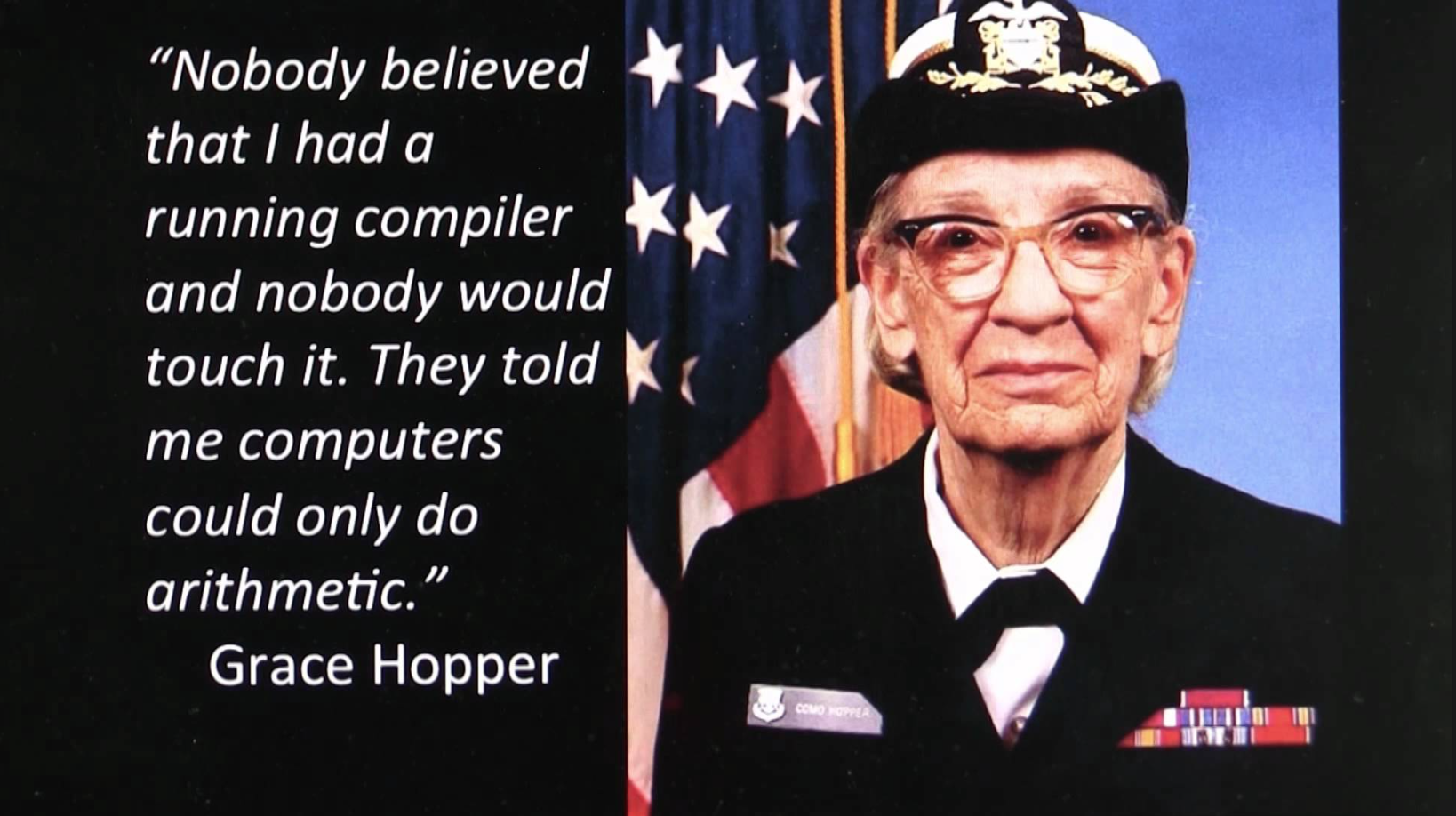
understand. This process came to be known as a "compiler", and the concept was at first dismissed by
her colleagues (see image at right). Hopper was undeterred and created the compiler anyway4, and even this working example
was ignored by her coworkers. Again, Hopper continued and her work went on to become the
COmmon Business-Oriented Language, or COBOL.4 COBOL allowed for using more intuitive language
and made the field more accessible.
Here is an example of COBOL code:
ADD 1 TO x
ADD 1, a, b TO x ROUNDED, y, z ROUNDED

ADD a, b TO c
    ON SIZE ERROR
        DISPLAY "Error"
END-ADD

ADD a TO b
    NOT SIZE ERROR
        DISPLAY "No error"
    ON SIZE ERROR
        DISPLAY "Error"
(This code was copied from the Wikipedia page on
COBOL) Even a non-programmer can get a sense of what is happening here.
Hopper continued to work to improve standard and practices within the Navy and the U.S. government
over the remainder of her professional career. Hopper first retired from the Navy Reserve in
1966.4 She was later recalled to
active duty and retired a few times (in 1971 and 1985). After retirement, Grace traveled widely and
lectured on her experiences and the history of computing. During this team, she is reported to have
said, "If you ask me what accomplishment I’m most proud of, the answer would be all the young people
I’ve trained over the years; that’s more important than writing the first compiler."1 Hopper believed
that the computer science field needed young people and their new ideas in order to keep moving
forward. Grace Hopper died of natural causes in 1992.2 She was 85 years
old.